


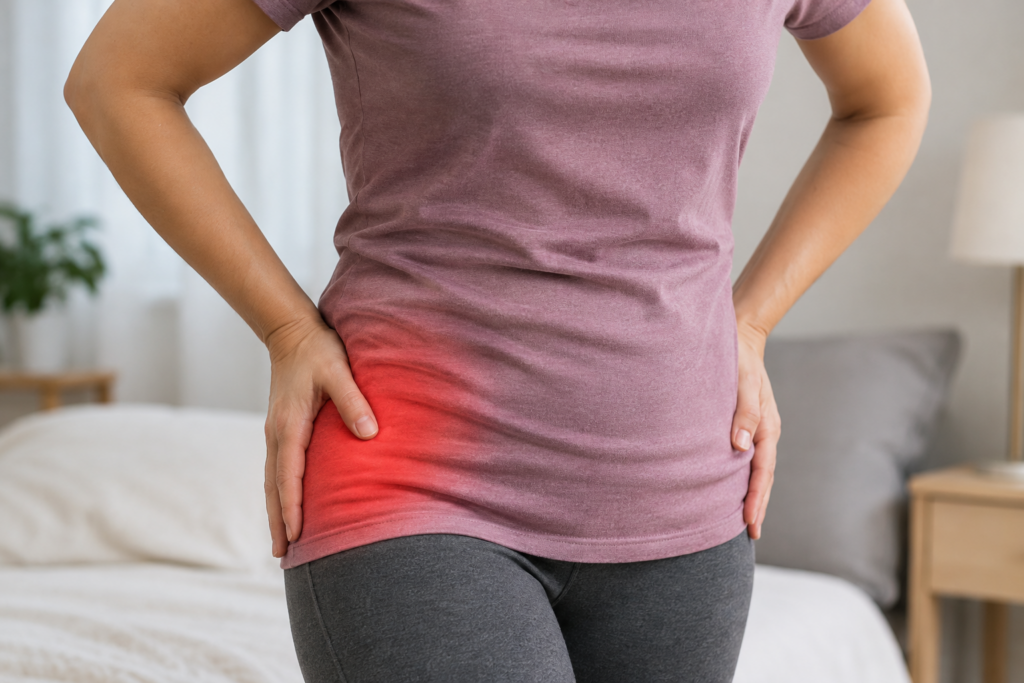
Hip pain at night can make sleeping difficult, especially when lying on your side. From tendon problems to arthritis and referred back pain, several conditions may be responsible. This guide explains the common causes, ways to relieve discomfort and when to seek specialist treatment.
You settle into bed, turn onto your favourite side and feel a familiar ache around your hip. Perhaps the discomfort builds gradually until you have to change position. You might wake several times during the night or find that your hip feels stiff and painful when you first get out of bed.
For some people, the problem begins after increasing their walking or exercise. For others, it develops gradually without an obvious injury.
Although the pain may feel as though it is coming directly from the hip joint, several different structures can produce symptoms in this area. These include the tendons around the hip, the joint itself, surrounding muscles and nerves originating in the lower back.
Identifying the source of the pain is important because treatment for a tendon condition can be quite different from treatment for hip osteoarthritis or a spinal nerve problem.
Why Does My Hip Hurt More at Night?
Hip pain may become more noticeable at night because of the position of the joint, pressure on surrounding tissues and changes in how the body responds to discomfort during rest.
When you lie on your side, your body weight places pressure on the outer part of the hip. If the tendons or other soft tissues in this area are sensitive, this pressure can aggravate the pain.
The position of your upper leg can also matter. If the leg drops across your body while sleeping, it can increase compression of the tissues around the outside of the hip.
For someone with an underlying hip joint condition, remaining in one position for several hours may contribute to stiffness and discomfort.
Pain can also feel more noticeable when you are trying to sleep because there are fewer competing sensations and distractions.
However, night-time hip pain is a symptom rather than a diagnosis. It should not automatically be attributed to sleeping position, particularly if it is persistent, progressive or accompanied by other concerning symptoms.
The NHS guidance on hip pain identifies several possible causes, including soft-tissue problems, arthritis and injuries. It also recommends medical assessment when hip pain repeatedly affects sleep or normal activities.
What Are the Most Common Causes of Hip Pain When Lying on Your Side?
The location of the pain can provide useful information.
Pain on the outside of the hip is often associated with tendons and other structures surrounding the greater trochanter.
Pain deep in the groin may be more suggestive of a problem involving the hip joint itself.
Discomfort in the buttock or pain extending down the leg may sometimes originate from the lower back.
These patterns are not definitive, but they can help guide a clinical assessment.
1. Greater Trochanteric Pain Syndrome (GTPS)
Greater trochanteric pain syndrome, or GTPS, is a common cause of pain on the outside of the hip.
The greater trochanter is the prominent bony area on the outer side of the upper thigh bone. Several muscles and tendons attach around this region and help stabilise the hip during walking and standing.
GTPS is an umbrella term describing pain associated with structures around this area, particularly the gluteal tendons.
The condition has historically been called trochanteric bursitis, although inflammation of the bursa is not always the main problem.
In many patients, the symptoms are more closely associated with gluteal tendinopathy, which involves changes or irritation affecting the tendons.
What does GTPS feel like?
Patients commonly describe an aching, sharp or sometimes burning pain over the outside of the hip.
The discomfort may extend down the outer thigh and can occasionally be felt as far as the knee.
Typical symptoms include:
- Pain when lying directly on the affected hip.
- Tenderness when pressing the outer side of the hip.
- Difficulty sleeping because of discomfort.
- Pain when walking upstairs or uphill.
- Discomfort when standing on one leg.
- Pain when rising from a chair after sitting.
- Symptoms that worsen after longer walks or increased activity.
For example, someone may be able to walk comfortably for short distances but develop increasing pain after a longer shopping trip. Later that evening, lying on the affected side may become particularly uncomfortable.
GTPS is seen frequently in middle-aged adults, although it can affect people of different ages.
Changes in physical activity, reduced muscle strength and increased loading of the hip tendons can contribute to symptoms.
The Royal National Orthopaedic Hospital’s patient guide to gluteal tendinopathy explains how tendon loading, compression and muscle strength can influence symptoms.
How is GTPS treated?
Treatment usually begins with a combination of activity modification and a progressive exercise programme.
This may involve reducing positions that compress the painful tendons, improving hip muscle strength and gradually increasing tolerance to everyday activities.
For some patients, additional pain management treatments may be considered.
However, an injection is not automatically necessary, and improving tendon strength and function remains an important part of longer-term management.
2. Gluteal Tendinopathy
Gluteal tendinopathy is closely related to GTPS and is one of the principal conditions responsible for persistent pain on the outside of the hip.
The gluteus medius and gluteus minimus muscles help control movement and stabilise the pelvis.
Their tendons attach to the greater trochanter.
Every time you walk, climb stairs or stand on one leg, these tendons help support your body.
Problems can develop when the tendons are exposed to more activity than they can currently tolerate.
For example, someone who normally walks for 15 minutes daily might suddenly begin walking for an hour each day.
Although walking is generally beneficial, a rapid increase in activity can sometimes aggravate sensitive tendons.
Conversely, prolonged inactivity may reduce strength and the tendons’ ability to tolerate normal activity.
Why does gluteal tendinopathy hurt when sleeping?
When lying on the affected side, the body presses directly against the sensitive outer hip.
Even lying on the opposite side can sometimes cause discomfort if the upper leg falls across the body.
This position brings the affected tendons closer to the underlying bone and increases compression.
The result can be a deep ache that becomes more noticeable after remaining in bed for some time.
It is important to recognise that gluteal tendinopathy and GTPS are not entirely separate diagnoses. Gluteal tendinopathy is often a major component of GTPS.
The Cambridge University Hospitals guidance on gluteal tendinopathy provides useful information about symptoms, sleeping positions and rehabilitation.
3. Hip Osteoarthritis
Osteoarthritis is another common cause of hip pain, particularly in adults over 45.
It is a condition affecting the whole joint, involving changes to cartilage, bone and other joint tissues.
Although osteoarthritis is often described as wear and tear, it is more complex than simply the gradual wearing away of cartilage.
Some people have significant changes visible on an X-ray but relatively little pain, while others experience considerable discomfort.
Where is arthritis pain usually felt?
Hip osteoarthritis often produces pain in the groin or deep within the hip.
However, discomfort may also be felt around the buttock, thigh or knee.
Other symptoms can include:
- Stiffness when first getting up in the morning.
- Pain after walking or standing for longer periods.
- Difficulty putting on socks or shoes.
- Reduced ability to rotate the hip.
- Discomfort getting in and out of a car.
- Increasing difficulty with everyday activities.
As the condition progresses, pain may occur during rest and at night.
How is arthritis-related night pain different?
A person with hip osteoarthritis may experience deeper joint pain rather than tenderness limited to the outside of the hip.
Movement may become restricted, and activities requiring hip rotation can be uncomfortable.
However, hip arthritis and GTPS can occur together.
A patient may therefore have more than one source of pain.
The NICE guideline on osteoarthritis in over-16s recommends therapeutic exercise tailored to the individual and explains when medication or other treatments may be considered.
For patients with persistent joint discomfort, Pain Consultants provides information about joint pain assessment and treatment options.
4. Pain Referred From the Lower Back
Sometimes the hip itself is not the source of the problem.
Conditions affecting the lumbar spine can cause pain that is felt around the buttock, outer hip or leg.
This is known as referred pain.
Certain spinal conditions can also irritate or compress nerve roots, producing pain that travels into the lower limb.
Examples include disc-related nerve irritation and narrowing of spaces around the spinal nerves.
What symptoms suggest a spinal cause?
Pain originating from the lower back may be associated with:
- Discomfort extending from the back into the buttock.
- Pain travelling down the thigh or below the knee.
- Tingling or pins and needles.
- Numbness in part of the leg.
- Burning or electric-shock-like sensations.
- Weakness in certain muscles.
- Symptoms affected by spinal position or movement.
Not everyone with a spinal condition experiences noticeable lower back pain.
Some patients mainly report discomfort in the buttock or leg.
This can make it difficult to distinguish a spinal problem from a hip condition without a proper examination.
Why does identifying the source matter?
Treatment directed at the hip tendons may provide little benefit if the principal cause is irritation of a spinal nerve.
Similarly, treatment for a spinal condition may not resolve pain caused by GTPS.
A clinician may need to assess hip movement, spinal movement, muscle strength, reflexes and sensation.
Pain Consultants offers assessment and treatment services for spinal pain and sciatica, which may be relevant when symptoms involve both the hip and lower back.
5. Hip Flexor Problems and Muscle Strains
Muscles around the hip can also become painful following injury or increased physical activity.
The hip flexor muscles are involved in lifting the leg and moving the hip forwards.
Strains or irritation affecting these muscles may produce discomfort towards the front of the hip or groin.
Other muscles around the pelvis can become painful following unfamiliar exercise, repetitive activities or sudden movements.
Typical features include:
- Pain following a specific activity or increase in exercise.
- Tenderness in the affected muscle.
- Discomfort when performing particular movements.
- Pain when lifting or moving the leg against resistance.
- Symptoms that improve gradually as the tissue recovers.
Muscle-related pain is often aggravated by movement, although certain sleeping positions can also be uncomfortable.
If symptoms are persistent, severe or not following the expected recovery pattern, further assessment may be necessary.
6. Inflammatory Conditions
Some inflammatory conditions can cause pain affecting the hips and surrounding joints.
Unlike many mechanical problems, inflammatory conditions may be associated with prolonged morning stiffness, swelling or symptoms affecting multiple joints.
For example, inflammatory arthritis can cause joint pain and stiffness after periods of rest.
Certain conditions may also affect structures around the pelvis and spine.
Symptoms that could suggest an inflammatory problem include persistent stiffness, joint swelling, fatigue or pain affecting several joints.
These symptoms do not confirm a diagnosis, but they may indicate that further medical assessment is appropriate.
A clinician may consider blood tests, imaging or referral to another specialist if an inflammatory condition is suspected.
7. Less Common but Important Causes
Although many cases of night-time hip pain are related to common musculoskeletal conditions, some causes require more urgent investigation.
These can include:
Hip fractures: Particularly after a fall or injury, especially in older adults or people with osteoporosis.
Joint infection: A painful, hot or swollen hip accompanied by fever or feeling unwell requires urgent medical assessment.
Avascular necrosis: Reduced blood supply to part of the femoral head can damage bone and produce hip or groin pain.
Stress fractures: Repetitive loading can sometimes produce a fracture, particularly in people with relevant risk factors or recent substantial increases in activity.
Other serious conditions: Persistent unexplained pain, especially when associated with systemic symptoms, may require investigation for less common causes.
It is important not to assume that severe or progressively worsening pain is simply the result of an uncomfortable mattress.
Why Does My Hip Hurt When I Sleep on One Side but Not the Other?
This is a particularly common question among people with outer hip pain.
When you lie directly on a painful hip, pressure is concentrated over the greater trochanter.
If the surrounding tendons are sensitive, the pressure may aggravate symptoms.
For example, a person with right-sided GTPS may feel comfortable lying on their back but experience discomfort within minutes of turning onto their right side.
However, lying on the left side does not always eliminate the problem.
If the right leg is unsupported, it may drop across the body and place additional compression on the right gluteal tendons.
This explains why some patients experience pain when lying on either side.
A pillow between the knees can help support the upper leg and reduce this compression.
If both hips are painful, sleeping on the back may be more comfortable.
The most suitable position depends on the individual and the underlying cause of the symptoms.
Why Does My Hip Hurt When I Turn Over in Bed?
Turning over requires coordinated movement of the pelvis, hip joints, muscles and lower back.
If one of these structures is painful, changing position may aggravate symptoms.
For someone with hip osteoarthritis, rotating the hip may produce discomfort.
For someone with GTPS, the movement may compress or load sensitive tendons.
A patient with a spinal problem may notice symptoms when the lower back twists.
The precise location of the pain and the movements that reproduce it can provide useful diagnostic information.
If turning over causes persistent severe pain, particularly after an injury, medical assessment is important.
Why Does My Hip Hurt More in the Morning?
Morning discomfort can occur for several reasons.
After remaining in one position overnight, some people experience temporary stiffness when they first begin moving.
This is sometimes described as start-up pain.
For patients with GTPS, the first few steps after getting out of bed may be uncomfortable because the tendons have been relatively inactive overnight.
Hip osteoarthritis can also cause stiffness after rest.
The duration and nature of the stiffness are important.
For example, prolonged morning stiffness may lead a clinician to consider an inflammatory condition rather than a purely mechanical problem.
The presence of morning pain alone does not establish a diagnosis.
What Is the Best Sleeping Position for Hip Pain?
There is no single position that works for everyone.
However, certain adjustments can help reduce pressure on sensitive hip structures.
Sleeping on Your Back
For someone with pain on the outside of one or both hips, sleeping on the back may reduce direct pressure over the greater trochanter.
A pillow beneath the knees may help maintain a comfortable position.
This is not necessarily suitable for everyone, particularly people with other spinal or medical conditions that affect sleeping comfort.
Sleeping on the Unaffected Side
If only one hip is painful, lying on the opposite side may help.
Place a pillow between your knees to support the upper leg.
The aim is to prevent the painful hip from being pulled into an uncomfortable position.
A sufficiently supportive pillow may be more useful than a very thin one that allows the upper knee to drop towards the mattress.
Avoiding Direct Pressure
If lying on the painful hip consistently aggravates symptoms, try to avoid that position while the condition is particularly sensitive.
Some people also find that a mattress topper provides additional cushioning.
However, changing the mattress alone is unlikely to resolve an underlying tendon or joint condition.
Changing Position Carefully
If turning over is painful, moving slowly and using your arms to help reposition your body may reduce discomfort.
Avoid forcing your hip into a position that produces sharp pain.
For further guidance, the Kingston and Richmond NHS guidance on GTPS explains practical ways to reduce pressure on the affected hip.
How Can I Relieve Hip Pain at Night?
Management depends on the cause, but several general measures may help.
1. Adjust Activities That Aggravate Symptoms
If your pain is related to GTPS or gluteal tendinopathy, reducing excessive pressure and loading can help.
For example, you may benefit from temporarily reducing long hill walks, repeated stair climbing or activities that consistently aggravate the outer hip.
However, avoiding all movement is generally not advisable.
The aim is to reduce excessive irritation while maintaining appropriate activity.
2. Avoid Standing With Your Weight on One Hip
Many people habitually stand with most of their weight resting on one leg.
This position can increase compression of the gluteal tendons.
Standing with weight distributed more evenly may be more comfortable for someone with GTPS.
Similarly, avoiding prolonged sitting with the legs crossed may reduce irritation.
3. Consider Cold Therapy
Some people find that applying a cold pack helps temporarily reduce discomfort.
Wrap the pack in a towel rather than placing it directly against the skin.
The NHS recommends using an ice pack for up to 20 minutes at a time for appropriate musculoskeletal pain.
Avoid applying ice to areas with impaired sensation or circulation unless advised by a healthcare professional.
4. Review Your Pain Relief Options
Suitable pain relief may help patients remain active and participate in rehabilitation.
However, medication should be selected according to the individual’s health conditions and existing treatments.
For example, non-steroidal anti-inflammatory drugs (NSAIDs) are not suitable for everyone.
They may present additional risks for people with certain kidney, stomach or cardiovascular conditions.
A pharmacist or clinician can advise on appropriate options.
Long-term reliance on painkillers without establishing the cause of persistent pain is not an ideal management strategy.
5. Begin Appropriate Strengthening Exercises
For GTPS and gluteal tendinopathy, progressive strengthening is often central to recovery.
Exercises may focus on improving the capacity of the muscles that support and stabilise the pelvis.
However, exercises should be selected according to the patient’s symptoms and physical capabilities.
Some stretches that bring the leg across the body can increase compression of sensitive gluteal tendons and may aggravate GTPS.
This is one reason why generic hip stretching routines are not suitable for every type of hip pain.
A physiotherapist can help develop an appropriate exercise programme and adjust it as symptoms improve.
6. Review Your Walking and Exercise Routine
If symptoms began after a substantial increase in physical activity, consider whether your routine changed too quickly.
For example, increasing from a short daily walk to several miles every day may place additional demands on the tendons.
Temporarily adjusting distance, speed or terrain can help reduce aggravation.
The goal is usually to return gradually to normal activity rather than avoid exercise indefinitely.
7. Improve Your Sleep Routine
Persistent pain and poor sleep can influence one another.
Pain can interrupt sleep, while inadequate sleep may make discomfort harder to manage.
Maintaining consistent sleeping hours, reducing unnecessary sleep disturbances and finding a comfortable position may help.
However, sleep hygiene measures should complement appropriate medical assessment rather than replace it when symptoms are persistent.
Should I Stretch My Hip If It Hurts at Night?
Stretching is not automatically helpful for every hip condition.
For some muscle-related problems, gentle stretching may form part of rehabilitation.
However, in patients with gluteal tendinopathy, certain stretches can increase compression of sensitive tendons.
For example, pulling the affected leg firmly across the body may aggravate pain on the outside of the hip.
The most appropriate rehabilitation programme depends on the diagnosis.
This is why identifying the source of pain is more useful than following a general collection of hip exercises.
If a movement consistently produces sharp pain or a significant worsening of symptoms, it should be reviewed with a healthcare professional.
How Is Night-Time Hip Pain Diagnosed?
A clinical assessment usually begins with a detailed discussion of the patient’s symptoms.
The clinician may ask when the pain started, whether it followed an injury, where it is located and which activities make it better or worse.
Questions may also address sleep disturbance, walking tolerance, previous treatments and other medical conditions.
Understanding the Location of Pain
The location of pain can help identify possible causes.
Outer hip pain: May suggest GTPS or gluteal tendon problems.
Groin or deep hip pain: May suggest a condition affecting the hip joint, including osteoarthritis.
Buttock pain: May originate from the hip, pelvis or lower back.
Pain travelling below the knee: May raise suspicion of a nerve-related cause, particularly when accompanied by tingling or numbness.
These are general patterns rather than definitive diagnostic rules.
A patient may have overlapping conditions or experience pain in an area away from its source.
Physical Examination
The clinician may examine:
- Hip movement and flexibility.
- Tenderness around the greater trochanter.
- Muscle strength.
- Walking pattern.
- Ability to stand on one leg.
- Pain associated with specific movements.
- Lower back mobility.
- Neurological function when appropriate.
The examination helps narrow down the possible causes and determine whether additional investigations are required.
Pain Consultants offers a comprehensive pain assessment service that may be relevant for patients with persistent or complex symptoms.
Do I Need an X-Ray, Ultrasound or MRI Scan?
Not everyone with hip pain requires imaging.
In many cases, the diagnosis can be made using the medical history and physical examination.
For example, GTPS can often be identified clinically without an MRI scan.
Imaging may be useful when the diagnosis remains uncertain, another condition is suspected or symptoms fail to improve as expected.
X-Ray
An X-ray can help assess the bones and joint structure.
It may be appropriate when arthritis, fracture or another bony abnormality is suspected.
However, an X-ray does not show all soft-tissue problems.
Ultrasound
Ultrasound can help evaluate certain tendons, bursae and other superficial structures.
It may be considered when a soft-tissue problem is suspected or when image guidance is appropriate for a procedure.
MRI
MRI provides more detailed images of bones and soft tissues.
It may be useful when there is concern about a tendon tear, stress fracture, avascular necrosis or another condition requiring further investigation.
However, MRI findings must be interpreted alongside symptoms and examination findings.
Not every abnormality visible on imaging is responsible for a patient’s pain.
For patients with suspected osteoarthritis, NICE advises that routine imaging is not necessary when the clinical presentation is typical and there are no features suggesting another diagnosis.
What Treatments Are Available for Persistent Hip Pain?
Treatment should be based on the underlying diagnosis rather than the location of pain alone.
A patient with gluteal tendinopathy may require a different approach from someone with osteoarthritis or lumbar nerve irritation.
Physiotherapy and Rehabilitation
For many common causes of hip pain, physiotherapy is an important first-line treatment.
For GTPS, rehabilitation typically involves reducing aggravating compression and progressively strengthening the muscles around the hip.
The programme may also address walking patterns, activity levels and other factors contributing to symptoms.
For osteoarthritis, therapeutic exercise is recommended to improve strength, mobility and physical function.
Exercise should be tailored to the person’s needs and progressed appropriately.
Medication Management
Pain relief may be considered to help patients manage symptoms and continue with suitable activities.
The type of medication depends on the diagnosis, medical history and individual risk factors.
A specialist may review existing medicines, consider whether they remain appropriate and discuss alternatives when necessary.
Medication is usually most useful as part of a wider management plan rather than the only treatment.
Corticosteroid Injections
Corticosteroid injections can be considered for selected patients with persistent hip pain.
However, the appropriate injection depends on the diagnosis.
For example, a patient with GTPS may receive an injection around the greater trochanteric region when clinically appropriate.
A patient with hip osteoarthritis may be considered for an injection into the hip joint.
These are different procedures targeting different structures.
How effective are steroid injections?
An injection may provide temporary pain relief.
For some patients, reducing pain can make it easier to participate in physiotherapy and everyday activities.
However, the duration and extent of benefit vary.
For osteoarthritis, NICE states that intra-articular corticosteroid injections may be considered in selected circumstances and generally provide short-term relief, typically around two to ten weeks.
Injections do not reverse osteoarthritis or repair damaged tendons.
The potential benefits should therefore be weighed against the risks and limitations.
These may include temporary pain flare, infection, bleeding and other procedure-specific complications. Corticosteroids may also temporarily increase blood glucose levels in people with diabetes.
Repeated injections require particular consideration, especially where tendon health may be affected.
Pain Consultants provides information about its joint injection services.
For a broader discussion of why injections do not always resolve persistent joint symptoms, patients may also find our article Why Does My Knee Still Hurt After a Steroid Injection? helpful.
Specialist Pain Management
If hip pain persists despite appropriate initial treatment, specialist assessment may help clarify the diagnosis and review management options.
This can be particularly useful where:
- Pain has continued for several months.
- Sleep is consistently disrupted.
- Symptoms interfere with work or daily activities.
- Several treatments have provided limited benefit.
- There may be more than one source of pain.
- Hip pain occurs alongside persistent back or nerve pain.
Depending on the diagnosis, treatment may involve rehabilitation, medication optimisation, selected procedures or referral to another appropriate specialist.
Not every patient requires an injection or invasive intervention.
In some cases, the most valuable outcome of specialist assessment is identifying why previous treatment has not worked and developing a more appropriate management plan.
What If My Hip Pain Does Not Improve After Physiotherapy?
Persistent symptoms do not necessarily mean that physiotherapy has failed.
Several factors may influence progress.
The original diagnosis may need reconsideration, particularly if the symptoms do not fit the expected pattern.
The exercise programme may also require adjustment.
For example, a programme that progresses too quickly may aggravate a sensitive tendon, while exercises that are too limited may not provide sufficient strengthening.
Other conditions, including hip osteoarthritis or spinal problems, may also contribute to pain.
A review may consider whether the exercises were appropriate, how consistently they were performed and whether additional investigations are warranted.
For some patients, a multidisciplinary approach is helpful.
This may involve coordination between pain medicine, physiotherapy, primary care and other specialists where clinically indicated.
How Long Does It Take for Night-Time Hip Pain to Improve?
Recovery depends on the cause and severity of the condition.
A mild muscle strain may improve over a relatively short period.
GTPS and gluteal tendinopathy can take several months to respond to rehabilitation, particularly when symptoms have been present for a long time.
Hip osteoarthritis is generally managed as a longer-term condition, with treatment focused on improving function and reducing symptoms.
The recovery process is not always linear.
Patients may experience periods of improvement followed by temporary flare-ups, particularly after changes in activity.
This does not automatically mean that the condition is deteriorating.
However, persistent or worsening pain should prompt a review of the diagnosis and treatment plan.
When Should You See a Pain Management Specialist?
If hip pain has become a persistent problem, specialist advice may help identify the cause and appropriate next steps.
Consider arranging an assessment if:
- Hip pain regularly wakes you during the night.
- You cannot sleep comfortably on either side.
- Symptoms persist despite appropriate self-care.
- Pain limits walking, exercise or work.
- You have difficulty performing normal daily activities.
- Treatment has provided little or only temporary improvement.
- You have hip pain together with back pain or neurological symptoms.
- The diagnosis remains uncertain.
A specialist can review the history of your symptoms, examine the relevant structures and consider whether investigations or additional treatment are needed.
Patients who would like to explore private assessment can book a consultation with Pain Consultants.
When Is Hip Pain a Medical Emergency?
Most episodes of hip pain are not medical emergencies.
However, certain symptoms require urgent attention.
Seek Urgent Medical Advice
Contact your GP urgently or NHS 111 if:
- You develop sudden severe hip pain without an obvious injury.
- Your hip becomes hot or swollen.
- You have hip pain accompanied by fever or feeling generally unwell.
- Your symptoms are rapidly worsening.
These symptoms may indicate a condition requiring prompt investigation, including infection.
Attend A&E or Call 999
Seek emergency medical assistance if:
- You have severe hip pain after a fall or injury.
- You cannot stand or bear weight on the affected leg.
- You develop significant loss of sensation following an injury.
If hip or leg pain occurs with lower back symptoms, emergency assessment is also necessary for new bladder or bowel dysfunction, numbness around the genitals or bottom, or severe or worsening weakness affecting both legs.
These symptoms can indicate a serious spinal condition.
Further information is available from the NHS hip pain guidance and NHS guidance on sciatica.
Frequently Asked Questions
Why does my hip hurt at night when I lie on my side?
Pain when lying on your side is commonly associated with greater trochanteric pain syndrome or gluteal tendinopathy. Pressure on sensitive tissues around the outside of the hip can aggravate symptoms. However, arthritis, referred spinal pain and other conditions may also contribute.
Is hip pain at night a sign of arthritis?
It can be, particularly when accompanied by groin pain, stiffness and restricted hip movement. However, night-time pain alone does not establish a diagnosis of arthritis.
Why does my hip hurt when I lie on the opposite side?
When lying on the unaffected side, the upper leg may fall across the body and increase compression of the gluteal tendons around the painful hip. Placing a pillow between the knees may help reduce this pressure.
Can a bad mattress cause hip pain?
An uncomfortable or unsupportive mattress may aggravate existing symptoms by increasing pressure on sensitive areas. However, persistent hip pain should not automatically be blamed on the mattress, as an underlying musculoskeletal condition may be present.
Why do I wake up with hip pain every morning?
Morning pain can occur after remaining in one position overnight. Tendon problems, osteoarthritis and inflammatory conditions can all contribute to discomfort after rest. The duration of stiffness and associated symptoms can help guide assessment.
Can hip pain be caused by sciatica?
Yes. Conditions affecting the lumbar spine can produce pain felt around the buttock, hip or leg. Sciatica may also cause tingling, numbness or radiating pain.
What is the best sleeping position for hip bursitis?
For pain associated with GTPS, sleeping on your back or on the unaffected side with a pillow between the knees may help reduce compression of sensitive tissues.
Should I walk if my hip hurts?
In many cases, remaining gently active is beneficial. However, the amount and type of activity should be adjusted according to the underlying condition. If walking consistently aggravates symptoms, a clinician or physiotherapist can advise on appropriate modifications.
Can a steroid injection help hip pain?
A corticosteroid injection may help selected patients, depending on the diagnosis. The benefit is often temporary, and injections are not always the preferred first-line treatment. Rehabilitation and other management strategies may still be necessary.
Can hip pain at night be serious?
Most cases relate to common musculoskeletal conditions. However, persistent unexplained pain, progressive symptoms, fever, inability to bear weight or other concerning features require medical assessment.
Will an MRI show why my hip hurts?
MRI can identify some structural abnormalities, but it is not necessary for every patient. A clinical examination is important because imaging findings do not always explain symptoms.
When should I see a specialist for hip pain?
Consider specialist assessment when pain repeatedly affects sleep, persists despite appropriate initial treatment, limits daily activities or has an uncertain cause.
Understanding and Managing Persistent Hip Pain
Hip pain that interrupts your sleep can affect far more than your comfort at night.
Poor sleep may leave you feeling tired, reduce your ability to exercise and make everyday activities more difficult.
The good news is that many common causes of hip pain can be managed with an appropriate combination of education, activity modification, rehabilitation and other treatments when clinically indicated.
However, successful management begins with understanding the source of the pain.
A person with gluteal tendinopathy may benefit from a carefully progressed strengthening programme and reducing compression of sensitive tendons.
Someone with hip osteoarthritis may require a different approach focused on maintaining mobility, strengthening the surrounding muscles and managing joint symptoms.
A patient whose pain originates from the lumbar spine may need assessment and treatment directed at the back rather than the hip.
This is why persistent hip pain should be assessed according to the individual symptoms and clinical findings rather than treated as a single condition.
Specialist Hip and Joint Pain Assessment at Pain Consultants
If hip pain is affecting your sleep, mobility or quality of life, understanding the underlying cause is the first step towards choosing an appropriate treatment.
At Pain Consultants, our consultant-led services focus on assessing persistent pain and considering management options tailored to each patient’s condition.
Patients experiencing ongoing hip pain, joint discomfort or symptoms involving the lower back may benefit from a specialist assessment, particularly when previous treatment has not provided sufficient improvement.
Depending on the diagnosis, management may include rehabilitation, medication review, appropriate interventions or referral to another specialist.
Our aim is to help patients understand their symptoms and make informed decisions about the options available to them.
If you are experiencing persistent hip pain, you can book a consultation with Pain Consultants to discuss your symptoms and explore suitable next steps.
Medical disclaimer: This article provides general educational information and is not a substitute for professional medical advice, diagnosis or treatment. Treatment suitability varies between individuals. Seek urgent medical assistance if you experience severe or rapidly worsening symptoms, signs of infection, inability to bear weight or concerning neurological symptoms.